
'/%3e%3cdefs%3e%3clinearGradient%20id='prefix__paint0_linear_4737_37157'%20x1='3.018'%20y1='23.6'%20x2='44.925'%20y2='24.977'%20gradientUnits='userSpaceOnUse'%3e%3cstop%20stop-color='%231CB7FF'/%3e%3cstop%20offset='.502'%20stop-color='%232FF58B'/%3e%3c/linearGradient%3e%3c/defs%3e%3c/svg%3e)


JEFF POWELL MBE - My crazy brushes with Argentinian football: Diego Maradona's Hand of God revelation to Terry Venables and I over dinner, a boozy Naples night with the little genius and joining their '78 World Cup winners for a Buenos Aires run
Jul 14 2026 16:48 · By Jeff Powell Mbe · 19 Reads


It was the hungover morning after Argentina won their first World Cup that the invitation came from their manager Cesar Luis Menotti to join him and his players that evening in the bar of a small hotel discreetly tucked away in downtown Buenos Aires.
The personal message was delivered by our mutual friend Hans Henningsen, the doyen of South American football reporters and commentators.
When we arrived the celebration was in full swing. Menotti explained they were gathered to fulfil his promise that if they won that 1978 edition of the World Cup, they would run bare-chested through the streets with the Argentine people.
‘Please run with us,’ he said. ‘
England
(who had failed to qualify) should have some representation in this tournament’. As we took off our shirts he distributed blue and white bandanas to be worn as we trotted out into crowds growing as word spread as to the whereabouts of their heroes.
‘To the Obelisk,’ Menotti cried. The symbolism of the 220ft-high monument to the birth of the Republic was not lost on Ossie Ardiles et al. It was on the steps of the Obelisk that the military junta had threatened to execute Menotti if he refused to select the infamous hatchet men of Boca Juniors and lost the World Cup.
‘If we cannot win by playing football,’ he said, ‘so be it.’ The courage required to stand by that principle defied belief, so real was the warning. This famously lean, languid bohemian known as
Flaco
(Slim) and for his chain-smoking in the dugout is ranked as the 22nd most important football manager of all time. In terms of heroism he has to stand first.
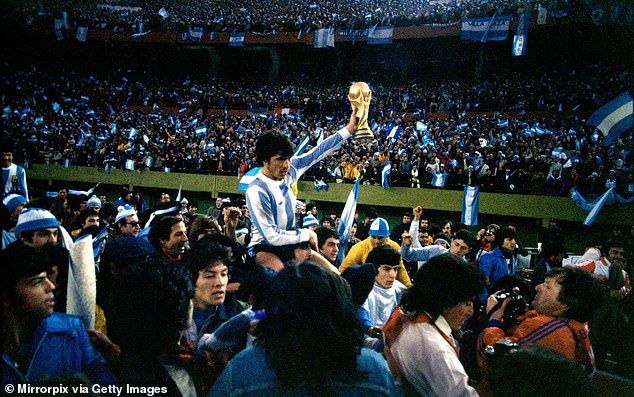
Argentina's Daniel Passarella holds aloft the World Cup after his country's victory in the 1978 final over the Netherlands. I joined the players the following day in Buenos Aires
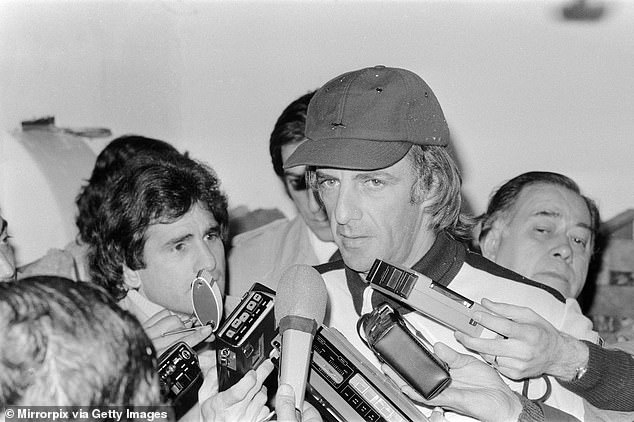
Argentina boss Cesar Luis Menotti speaks to the press after leading his side to World Cup glory. He bravely stood up to the military junta and picked the team he thought would win
When the Boca dispute was at its most menacing, he doubled down against the brutal Argentinian regime of the day by saying this: ‘There’s a right-wing football and a left-wing football. Right-wing football suggests life is a struggle demanding sacrifices in which you have to win by any method. Obey and function is what those in power demand of the players. That’s how they create r*****s. Useful idiots who go with the system.’
We ran, sweating on a hot and humid July night, on that belief. When we arrived back at the bar, Menotti edged me through the celebrant throng and introduced me to a small lad waiting patiently in a corner.
‘Meet Diego,’ he said. Of Mario Kempes, who had just scored twice in the extra-time victory over the Netherlands to claim not only his winner's medal but also the golden awards for top scorer and best player in the tournament, he added: ‘This good man is our present. This young man is our future’. The teenage Maradona who Menotti had deemed just a mite too young to play in this World Cup shook hands politely, saying: ‘
Mucho gusto, Senor
.’ (Pleased to meet you, Sir.)
Argentina and the Netherlands were scheduled to meet again a few months later in Switzerland in friendly commemoration of FIFA’s 75th anniversary. ‘Come to Bern,’ Menotti told me. 'Be among the first to see greatness in the making.’
So I went. Argentina won 8-7 on penalties but we had eyes only for Maradona who I described in these pages as an electrifying young genius. The next match of their European tour was at Hampden Park and before the game our Scottish colleagues made fun by saying: ‘Oh Jeff. Found the next Pele have you?’ Fifteen minutes into the game they walked along the press box to apologise, as little Diego was taking their team apart.
Four years after Menotti masterminded their first World Cup glory, Argentina drew Britain into war against them by invading the Falkland Islands. To them,
Las Malvinas
.
Margaret Thatcher was up to that challenge, which ended the
entente cordiale
between English and Argentine football which Menotti and Ardiles, by joining Spurs as Britain’s first major foreign signing, had helped create. They had dispersed the hostility between the two countries brought about by their 1966 World Cup quarter-final clash at Wembley. At the end of that ugly match England manager Alf Ramsey labelled the Argentinians as 'animals' and forbade his men to exchange shirts with them.
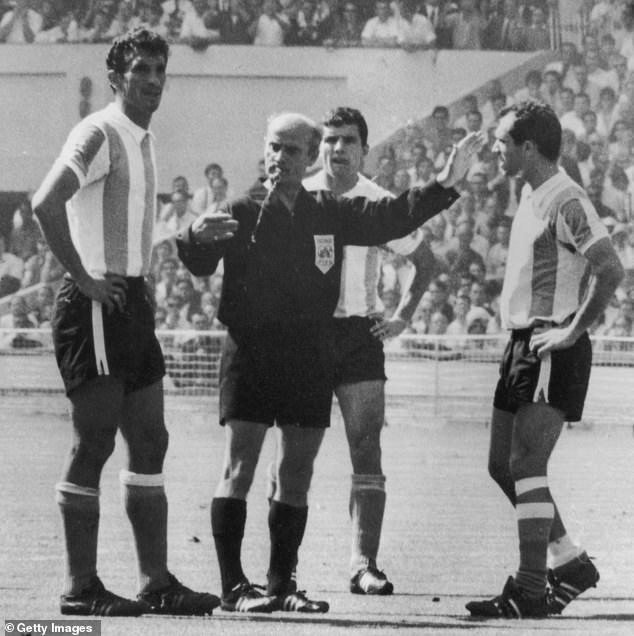
England captain Bobby Moore was more sanguine, more courteous, saying later: ‘If their captain Antonio Rattin hadn’t been sent off, none of the following World Cups would have taken place because we would still be playing a 0-0 draw against them ... and we would still be waiting to win our only World Cup.’ At that time there was no provision beyond extra time for settling deadlocked matches.
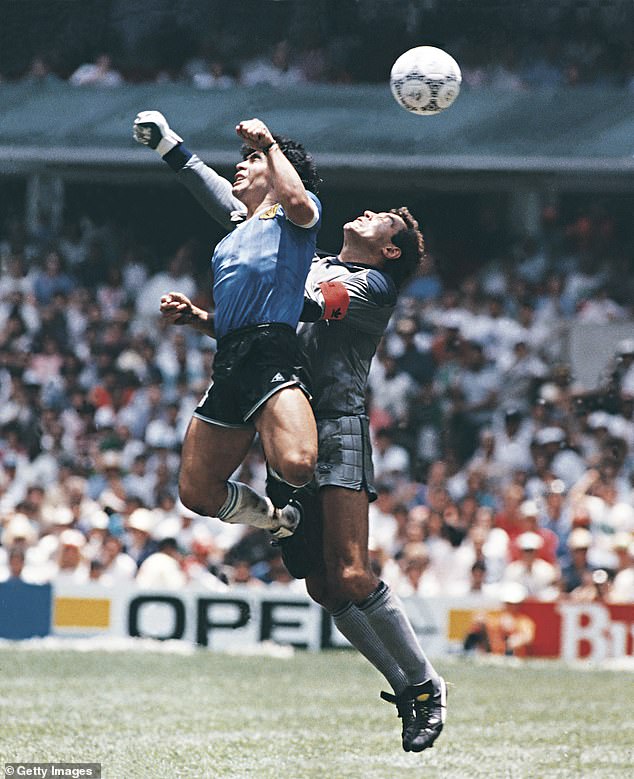
Diego Maradona's Hand of God goal - but he told Terry Venables and I that he feared he would get clattered by Peter Shilton and had no idea how the ball went in
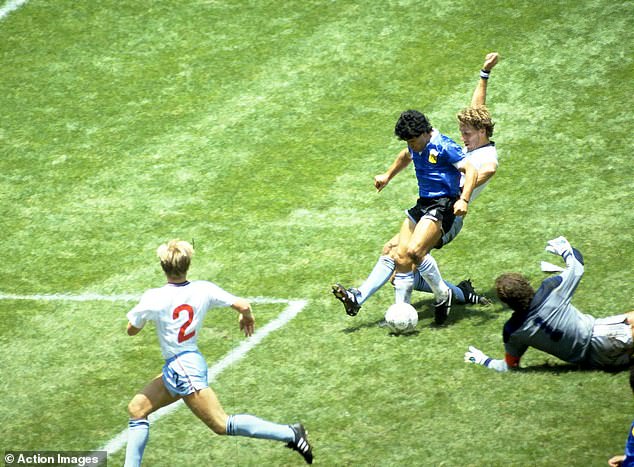
It was of no consolation to England’s players and fans that Maradona went on to score the Goal of the Century which sealed that 1986 World Cup quarter-final defeat
Argentina captain Antonio Rattin (left) is sent off during the 1966 World Cup clash with England. Alf Ramsey called the Argentinians 'animals' but Bobby Moore was more courteous
Well, more World Cups have occurred. At Mexico 1970 England lost the World Cup, without involvement against Argentina. But come 1986, again in Mexico, this time in the wake of the Falklands War, the old scars were reopened. Vividly. Almost religiously. By The Hand of God.
Say hello, again, to Senor Maradona. England, the perennial quarter-finalists, acclimatised perfectly for the 7,400 feet ascent to Mexico City’s Azteca Stadium only for little Diego to climb even higher with one raised arm.
No VAR, no redress for the referee missing that the ball had gone in off Maradona’s raised fist for a goal which, to rub salt in the wound, he credited to The Hand of God. That smart remark, however, was not the whole truth. Many thought it provided England with an excuse as well as that wee rascal to blame.
Although the incident came in a blur, close scrutiny of the still photographs reveal a somewhat different story. Maradona’s eyes are shut and his head is turned away as the miscued clearance by Steve Hodge deflects off his hand into the net. Then the reaction of the England players was focused on goalkeeper Peter Shilton’s reluctance to rise forcibly to the challenge. Their immediate instinct was to question why he did not flatten the smaller man. It was of no consolation to England’s players and fans that Maradona went on to score the Goal of The Century which sealed that defeat.
Maradona had fun with The Hand of God legend but later, curiously in Barcelona, he confirmed that he put up his hand ‘expecting to be battered by Shilton’ and ‘had no idea how it went into the goal’.
That admission was offered when he came to join the table in one of Catalunya’s finest seafood restaurants where Terry Venables and I were dining. The majority of the conversation covered the reasons Maradona gave for wanting to leave Barcelona so soon after Venables had become manager there.
‘Nothing to do with you, Meester,’ he told El Tel. ‘But as usual my life is complicated.’ A master of understatement, to boot. He was determined to join Napoli ‘for many reasons’. Venables determined there would be no point hanging on, even to such a great asset, if he would be mentally incapable of giving the team his all.
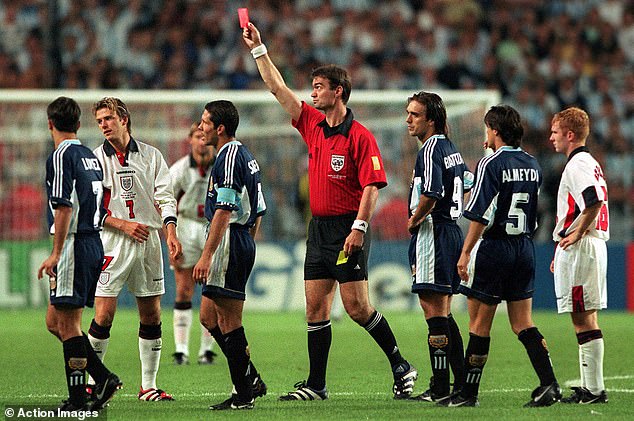
The fragile Anglo-Argentine accord suffered further duress when David Beckham was sent off – and for a while into purgatory at home – in a last-16 tie in France 1998. Golden Balls accused Diego Simeone of provoking him into lashing out with a petulant donkey kick against the captain of Argentina, who went on to win by penalties.
David Beckham is sent off in the World Cup match against Argentina in France in 1998
I had one unforgettable night with Maradona in Naples where he was treated like a God
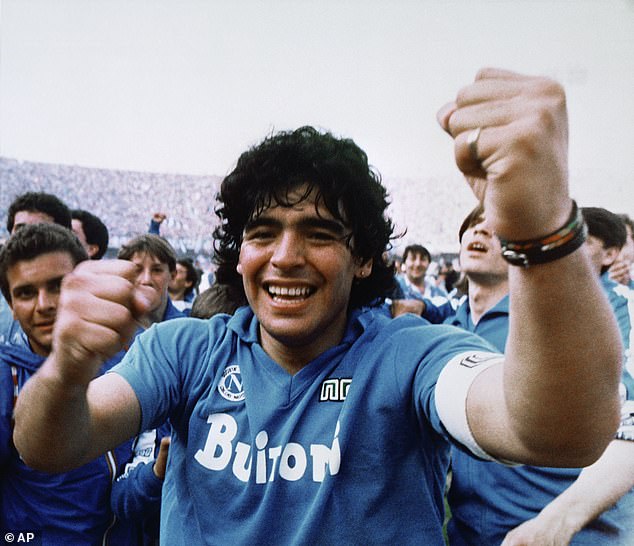
There would be further encounters down the years with Maradona. Memorably on a visit to Naples to report on the fervour of idolatry there which consumed the city to which he brought their first Serie A
championship. A trip which included one long, exhausting day and all-nighter as we did the rounds of his boozy friends, fawning girl groupies and, yes, drug suppliers.
The honesty was at times as disarming as the conduct could be alarming, But at his peak Maradona remains, for me at least, the second greatest footballer of all time. Behind Pele alone and still one above the successor to his Argentine throne Lionel Messi.
Before Menotti and Henningsen died the three of us paid a sentimental return to the small bar in which the teenage Maradona sat patiently awaiting his time to come.
Now, as England and Argentina prepare to renew hostilities in Atlanta, it is impossible not to wonder whether the war at the centre of it all might have been avoided had the heroic Cesar Luis Menotti been in power over his country rather than its football team when Thatcher was driven to war.
As the greatest of all Caesars used to amuse himself with me by asking: ‘What would your Prime Minister have said if survivors of the Spanish Armada had swum ashore on an island off the English coast and declared it to be their own territory?’